




Golang实现本地代理并注入Proxy-Authorization头转发至远程代理

Golang实现本地代理并注入Proxy-Authorization头转发至远程代理 我正在开发一个基于Go和Selenium的自动化工具,名为IGopher,并且收到了一些用户请求,希望实现原生代理支持。

然而,我在处理需要身份验证的代理时遇到了问题…… 我无法将代理凭据发送给Chrome,如果没有这些凭据,Chrome会通过一个弹窗要求进行身份验证,而我很难通过Selenium与之交互(我甚至不确定在无头模式下是否可能)。

因此,我想到一个方案:在我的程序中本地托管一个中间代理系统,该系统将添加“Proxy-Authorization”请求头,并将请求转发到远程代理。
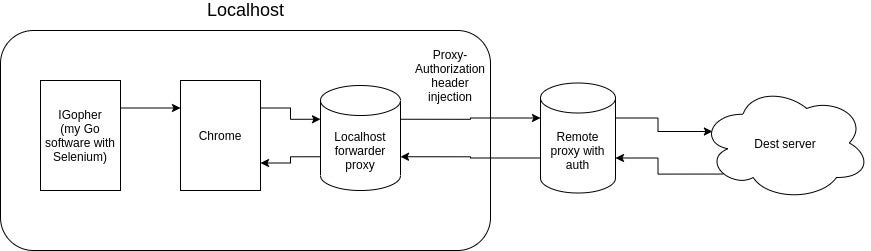
8sajmwxv4vm61

类似于这样的项目:proxy-login-automator

说实话,我对代理不是很熟悉,但我尝试了两种方法: 第一种是使用HandlerFunc:

var (
	localServerHost  string
	remoteServerHost string
	remoteServerAuth string
)

// ProxyConfig 存储所有远程代理配置
type ProxyConfig struct {
	IP       string `yaml:"ip"`
	Port     int    `yaml:"port"`
	Username string `yaml:"username"`
	Password string `yaml:"password"`
	Enabled  bool   `yaml:"activated"`
}

// LaunchForwardingProxy 启动转发服务器,用于将代理身份验证头注入到传出请求中
func LaunchForwardingProxy(localPort uint16, remoteProxy ProxyConfig) error {
	localServerHost = fmt.Sprintf("localhost:%d", localPort)
	remoteServerHost = fmt.Sprintf(
		"%s:%d",
		remoteProxy.IP,
		remoteProxy.Port,
	)
	remoteServerAuth = fmt.Sprintf(
		"%s:%s",
		remoteProxy.Username,
		remoteProxy.Password,
	)

	handler := http.HandlerFunc(handleFunc)

	server := &http.Server{
		Addr:           ":8880",
		Handler:        handler,
		ReadTimeout:    10 * time.Second,
		WriteTimeout:   10 * time.Second,
		MaxHeaderBytes: 1 << 20,
	}

	go func() {
		if err := server.ListenAndServe(); err != nil {
			logrus.Fatal(err)
		}
	}()
	logrus.Infof("端口转发服务器已启动并在 %s 上监听", localServerHost)

	// 设置信号捕获
	stop := make(chan os.Signal, 1)
	signal.Notify(stop, os.Interrupt)

	// 等待SIGINT信号 (pkill -2)
	<-stop

	ctx, cancel := context.WithTimeout(context.Background(), 5*time.Second)
	defer cancel()
	if err := server.Shutdown(ctx); err != nil {
		logrus.Errorf("转发代理关闭失败: %v", err)
	}
	logrus.Info("转发代理已停止")

	return nil
}

func handleFunc(w http.ResponseWriter, r *http.Request) {
	// 将代理身份验证头注入到传出请求的新Header中
	basicAuth := "Basic " + base64.StdEncoding.EncodeToString([]byte(remoteServerAuth))
	r.Header.Add("Proxy-Authorization", basicAuth)

	// 为远程代理准备新请求
	bodyRemote, err := ioutil.ReadAll(r.Body)
	if err != nil {
		http.Error(w, err.Error(), http.StatusInternalServerError)
		return
	}

	/*准备新请求
		这部分我不太确定 */

	// 创建新请求
	hostURL := fmt.Sprintf("%s://%s", "http", remoteServerHost)
	proxyReq, err := http.NewRequest(r.Method, hostURL, bytes.NewReader(bodyRemote))
	if err != nil {
		http.Error(w, "无法创建新请求", 500)
		return
	}

	// 复制请求头
	proxyReq.Header = r.Header
	logrus.Info(proxyReq)
	
	/* 请求准备结束 */

	// 将请求转发到远程代理服务器
	httpClient := http.Client{}
	resp, err := httpClient.Do(proxyReq)
	if err != nil {
		logrus.Info(err)
		http.Error(w, "无法连接到源服务器", 500)
		return
	}
	defer resp.Body.Close()

	logrus.Infof("响应: %v", resp)

	// 将响应头从源服务器传输到客户端
	for name, values := range resp.Header {
		w.Header()[name] = values
	}
	w.WriteHeader(resp.StatusCode)

	// 将响应体从源服务器传输到客户端
	if resp.ContentLength > 0 {
		io.CopyN(w, resp.Body, resp.ContentLength)
	} else if resp.Close {
		// 复制直到EOF或发生其他错误
		for {
			if _, err := io.Copy(w, resp.Body); err != nil {
				break
			}
		}
	}
}

使用这段代码,我能够拦截请求并更新请求头。然而,目前的情况是,我只向我的代理发送了一个CONNECT请求,所以它完全没用:

&{CONNECT http://<PROXY_IP>:3128 HTTP/1.1 1 1 map[Connection:[keep-alive] Proxy-Authorization:[Basic <auth>] Proxy-Connection:[keep-alive] User-Agent:[Mozilla/5.0 (X11; Ubuntu; Linux x86_64; rv:86.0) Gecko/20100101 Firefox/86.0]] {} 0x71fe20 0 [] false <PROXY_IP>:3128 map[] map[] <nil> map[]   <nil> <nil> <nil> 0xc0000260e0} 

我认为我需要更改NewRequest的URL,但我不知道该放什么……

我也尝试了使用NewSingleHostReverseProxy:

func PrintResponse(r *http.Response) error {
	logrus.Infof("Response: %+v\n", r)
	return nil
}

// LaunchForwardingProxy launch forward server used to inject proxy authentication header
// into outgoing requests
func LaunchForwardingProxy(localPort uint16, remoteProxy ProxyConfig) error {
	localServerHost = fmt.Sprintf("localhost:%d", localPort)
	remoteServerHost = fmt.Sprintf(
		"http://%s:%d",
		remoteProxy.IP,
		remoteProxy.Port,
	)
	remoteServerAuth = fmt.Sprintf(
		"%s:%s",
		remoteProxy.Username,
		remoteProxy.Password,
	)

	remote, err := url.Parse(remoteServerHost)
	if err != nil {
		panic(err)
	}

	proxy := httputil.NewSingleHostReverseProxy(remote)
	d := func(req *http.Request) {
		logrus.Infof("Pre-Edited request: %+v\n", req)
		// Inject proxy authentication headers to outgoing request into new Header
		basicAuth := "Basic " + base64.StdEncoding.EncodeToString([]byte(remoteServerAuth))
		req.Header.Set("Proxy-Authorization", basicAuth)
		// Change host to the remote proxy
		req.URL = remote
		logrus.Infof("Edited Request: %+v\n", req)
		logrus.Infof("Scheme: %s, Host: %s, Port: %s\n", req.URL.Scheme, req.URL.Host, req.URL.Port())
	}
	proxy.Director = d
	proxy.ModifyResponse = PrintResponse
	http.ListenAndServe(localServerHost, proxy)

	return nil
}

同样,我成功拦截了请求并编辑了请求头,但这次CONNECT请求转发失败,并出现以下错误信息:

INFO[0007] Pre-Edited request: &{Method:CONNECT URL://google.com:443 Proto:HTTP/1.1 ProtoMajor:1 ProtoMinor:1 Header:map[Proxy-Connection:[Keep-Alive] User-Agent:[curl/7.68.0]] Body:<nil> GetBody:<nil> ContentLength:0 TransferEncoding:[] Close:false Host:google.com:443 Form:map[] PostForm:map[] MultipartForm:<nil> Trailer:map[] RemoteAddr:127.0.0.1:46672 RequestURI:google.com:443 TLS:<nil> Cancel:<nil> Response:<nil> ctx:0xc0002986c0}  function=func1 line=58

INFO[0007] Edited Request: &{Method:CONNECT URL://google.com:443 Proto:HTTP/1.1 ProtoMajor:1 ProtoMinor:1 Header:map[Proxy-Authorization:[Basic aWdvcGhlcjpwYXNzd29yZA==] Proxy-Connection:[Keep-Alive] User-Agent:[curl/7.68.0]] Body:<nil> GetBody:<nil> ContentLength:0 TransferEncoding:[] Close:false Host:http://51.178.42.90:3128 Form:map[] PostForm:map[] MultipartForm:<nil> Trailer:map[] RemoteAddr:127.0.0.1:46672 RequestURI:google.com:443 TLS:<nil> Cancel:<nil> Response:<nil> ctx:0xc0002986c0}  function=func1 line=64

2021/03/14 12:10:07 http: proxy error: unsupported protocol scheme ""

如果你有办法完善我的做法,或者有其他方法,那就太好了! 我想我误解了请求结构以及URL/Host字段的作用。

你可以在这里找到IGopher的所有源代码:GitHub仓库(代理相关代码除外)


更多关于Golang实现本地代理并注入Proxy-Authorization头转发至远程代理的实战教程也可以访问 https://www.itying.com/category-94-b0.html

1 回复

更多关于Golang实现本地代理并注入Proxy-Authorization头转发至远程代理的实战系列教程也可以访问 https://www.itying.com/category-94-b0.html


要实现一个能够正确处理CONNECT请求的代理服务器,需要区分普通HTTP请求和HTTPS隧道请求。以下是完整的解决方案:

package main

import (
    "bufio"
    "bytes"
    "context"
    "crypto/tls"
    "encoding/base64"
    "fmt"
    "io"
    "log"
    "net"
    "net/http"
    "net/http/httputil"
    "net/url"
    "strings"
    "time"
)

type ProxyConfig struct {
    IP       string
    Port     int
    Username string
    Password string
}

type ProxyServer struct {
    config     *ProxyConfig
    httpClient *http.Client
}

func NewProxyServer(config *ProxyConfig) *ProxyServer {
    // 创建支持代理的HTTP客户端
    proxyURL := fmt.Sprintf("http://%s:%d", config.IP, config.Port)
    proxy, _ := url.Parse(proxyURL)
    
    transport := &http.Transport{
        Proxy: http.ProxyURL(proxy),
        TLSClientConfig: &tls.Config{
            InsecureSkipVerify: true,
        },
        DialContext: (&net.Dialer{
            Timeout:   30 * time.Second,
            KeepAlive: 30 * time.Second,
        }).DialContext,
        MaxIdleConns:          100,
        IdleConnTimeout:       90 * time.Second,
        TLSHandshakeTimeout:   10 * time.Second,
        ExpectContinueTimeout: 1 * time.Second,
    }
    
    // 设置代理认证
    if config.Username != "" && config.Password != "" {
        auth := config.Username + ":" + config.Password
        basicAuth := "Basic " + base64.StdEncoding.EncodeToString([]byte(auth))
        transport.ProxyConnectHeader = http.Header{
            "Proxy-Authorization": []string{basicAuth},
        }
    }
    
    return &ProxyServer{
        config: config,
        httpClient: &http.Client{
            Transport: transport,
            Timeout:   30 * time.Second,
        },
    }
}

func (p *ProxyServer) handleHTTP(w http.ResponseWriter, r *http.Request) {
    // 移除代理相关的头部
    r.RequestURI = ""
    r.URL.Scheme = "http"
    if r.URL.Host == "" {
        r.URL.Host = r.Host
    }
    
    // 复制请求体
    var bodyBytes []byte
    if r.Body != nil {
        bodyBytes, _ = io.ReadAll(r.Body)
        r.Body = io.NopCloser(bytes.NewBuffer(bodyBytes))
    }
    
    // 发送请求
    resp, err := p.httpClient.Do(r)
    if err != nil {
        http.Error(w, err.Error(), http.StatusBadGateway)
        return
    }
    defer resp.Body.Close()
    
    // 复制响应头
    for key, values := range resp.Header {
        for _, value := range values {
            w.Header().Add(key, value)
        }
    }
    w.WriteHeader(resp.StatusCode)
    
    // 复制响应体
    io.Copy(w, resp.Body)
}

func (p *ProxyServer) handleTunnel(w http.ResponseWriter, r *http.Request) {
    // 获取目标地址
    host := r.URL.Host
    if !strings.Contains(host, ":") {
        host = host + ":443"
    }
    
    // 连接到远程代理
    proxyConn, err := net.Dial("tcp", fmt.Sprintf("%s:%d", p.config.IP, p.config.Port))
    if err != nil {
        http.Error(w, err.Error(), http.StatusServiceUnavailable)
        return
    }
    defer proxyConn.Close()
    
    // 发送CONNECT请求到远程代理
    connectReq := fmt.Sprintf("CONNECT %s HTTP/1.1\r\n", host)
    connectReq += fmt.Sprintf("Host: %s\r\n", host)
    
    // 添加代理认证
    if p.config.Username != "" && p.config.Password != "" {
        auth := p.config.Username + ":" + p.config.Password
        basicAuth := "Basic " + base64.StdEncoding.EncodeToString([]byte(auth))
        connectReq += fmt.Sprintf("Proxy-Authorization: %s\r\n", basicAuth)
    }
    
    connectReq += "\r\n"
    
    _, err = proxyConn.Write([]byte(connectReq))
    if err != nil {
        http.Error(w, err.Error(), http.StatusBadGateway)
        return
    }
    
    // 读取代理响应
    reader := bufio.NewReader(proxyConn)
    resp, err := http.ReadResponse(reader, r)
    if err != nil {
        http.Error(w, err.Error(), http.StatusBadGateway)
        return
    }
    defer resp.Body.Close()
    
    if resp.StatusCode != 200 {
        http.Error(w, "Proxy connection failed", resp.StatusCode)
        return
    }
    
    // 劫持客户端连接
    hijacker, ok := w.(http.Hijacker)
    if !ok {
        http.Error(w, "Hijacking not supported", http.StatusInternalServerError)
        return
    }
    
    clientConn, _, err := hijacker.Hijack()
    if err != nil {
        http.Error(w, err.Error(), http.StatusServiceUnavailable)
        return
    }
    defer clientConn.Close()
    
    // 发送成功响应给客户端
    clientConn.Write([]byte("HTTP/1.1 200 Connection Established\r\n\r\n"))
    
    // 双向转发数据
    go func() {
        io.Copy(proxyConn, clientConn)
        proxyConn.Close()
    }()
    io.Copy(clientConn, proxyConn)
}

func (p *ProxyServer) ServeHTTP(w http.ResponseWriter, r *http.Request) {
    log.Printf("Received %s request for %s", r.Method, r.URL.String())
    
    if r.Method == "CONNECT" {
        p.handleTunnel(w, r)
    } else {
        p.handleHTTP(w, r)
    }
}

func StartProxyServer(localPort int, config *ProxyConfig) error {
    proxy := NewProxyServer(config)
    server := &http.Server{
        Addr:    fmt.Sprintf(":%d", localPort),
        Handler: proxy,
    }
    
    log.Printf("Starting proxy server on :%d", localPort)
    return server.ListenAndServe()
}

// 使用示例
func main() {
    config := &ProxyConfig{
        IP:       "51.178.42.90",
        Port:     3128,
        Username: "igopher",
        Password: "password",
    }
    
    if err := StartProxyServer(8880, config); err != nil {
        log.Fatal(err)
    }
}

对于更简单的实现,可以使用goproxy库:

package main

import (
    "crypto/tls"
    "encoding/base64"
    "fmt"
    "log"
    "net/http"
    "net/url"
    
    "github.com/elazarl/goproxy"
)

func StartGoproxyServer(localPort int, proxyIP string, proxyPort int, username, password string) {
    proxy := goproxy.NewProxyHttpServer()
    proxy.Verbose = true
    
    // 设置上游代理
    proxyURL := fmt.Sprintf("http://%s:%d", proxyIP, proxyPort)
    proxyURLParsed, _ := url.Parse(proxyURL)
    
    // 创建带认证的传输层
    transport := &http.Transport{
        Proxy: http.ProxyURL(proxyURLParsed),
        TLSClientConfig: &tls.Config{
            InsecureSkipVerify: true,
        },
    }
    
    // 设置代理认证头部
    if username != "" && password != "" {
        auth := username + ":" + password
        basicAuth := "Basic " + base64.StdEncoding.EncodeToString([]byte(auth))
        transport.ProxyConnectHeader = http.Header{
            "Proxy-Authorization": []string{basicAuth},
        }
    }
    
    proxy.Tr = transport
    
    log.Printf("Starting goproxy server on :%d", localPort)
    log.Fatal(http.ListenAndServe(fmt.Sprintf(":%d", localPort), proxy))
}

func main() {
    StartGoproxyServer(8880, "51.178.42.90", 3128, "igopher", "password")
}

在Selenium中使用这个本地代理:

package main

import (
    "fmt"
    "time"
    
    "github.com/tebeka/selenium"
)

func main() {
    // 启动本地代理服务器
    go StartProxyServer(8880, &ProxyConfig{
        IP:       "51.178.42.90",
        Port:     3128,
        Username: "igopher",
        Password: "password",
    })
    
    time.Sleep(2 * time.Second) // 等待代理服务器启动
    
    // 配置Selenium使用本地代理
    caps := selenium.Capabilities{
        "browserName": "chrome",
    }
    
    proxy := selenium.Proxy{
        Type: selenium.Manual,
        HTTP: "localhost:8880",
        SSL:  "localhost:8880",
    }
    caps.AddProxy(proxy)
    
    // 创建WebDriver实例
    wd, err := selenium.NewRemote(caps, "")
    if err != nil {
        panic(err)
    }
    defer wd.Quit()
    
    // 使用WebDriver
    wd.Get("https://example.com")
}

这个实现正确处理了CONNECT请求(用于HTTPS隧道)和普通HTTP请求,并自动添加Proxy-Authorization头部到上游代理。

回到顶部