




Golang中私有REST API的日志记录实现
Golang中私有REST API的日志记录实现 大家好,
我从未在生产环境中进行过日志记录,所以我的问题可能有些幼稚。
在我的微服务应用中,只有网关进行日志记录,其他服务仅使用以下结构将错误相互传递,直至网关:
type restErr struct {
    // 发送给前端
	ErrStatus  int    `json:"status"`  // HTTP 状态码
	ErrTitle   string `json:"title"`   // 状态码的字符串表示,如 "bad_request"
	ErrMessage string `json:"message"` // 发送给前端的可选消息

    // 不发送给前端,仅用于日志记录
	ErrError    error  `json:"error"`     // 由数据库、其他服务等返回的原始错误
	ErrErrorMsg string `json:"error_msg"` // ErrError 的字符串表示
	ErrCode     string `json:"code"`      // 来自数据库或其他服务的原始错误代码
}
错误由每个微服务的每一层包装,直至网关,网关会记录类似这样的错误:
2023-04-29T09:14:44+04:00 ERR | can't do what you want me to | error="gw.controllerX.MethodX: gw.httpclientY.MethodY: service1.controllerX.MethodX: service1.serviceY.MethodY: service2.controllerX.MethodX: service2.serviceY.MethodY: service2.repositoryY.MethodY: error 9009 in database" code=9009 correlationID=cgva1dg3lcjadv69n180 service=gw status=500
我确实有一个疑问,因为我相当确定我曾读到过一些应用仅从网关记录日志,但这会让我到处看到的 correlationID 变得完全无用。另一方面,我看到在 Go 中应该包装错误以便更好地跟踪执行路径,所以我有点困惑……任何建议对我来说都弥足珍贵。
以下是一个说明图:
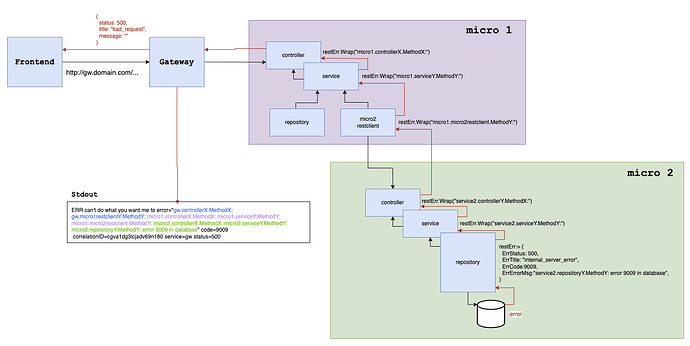
以及原始图表的链接,以便更清晰地查看:logging with microservices - Google Drive
非常感谢。
更多关于Golang中私有REST API的日志记录实现的实战教程也可以访问 https://www.itying.com/category-94-b0.html
1 回复

更多关于Golang中私有REST API的日志记录实现的实战系列教程也可以访问 https://www.itying.com/category-94-b0.html
在微服务架构中,日志记录策略确实需要仔细设计。你的 restErr 结构体设计合理,但仅网关记录日志确实会丢失关键调试信息。以下是完整的实现方案:
1. 增强错误结构体
type RestErr struct {
    // 客户端可见字段
    Status  int    `json:"status"`
    Title   string `json:"title"`
    Message string `json:"message"`

    // 内部调试字段
    Err        error  `json:"-"`
    ErrMsg     string `json:"-"`
    Code       string `json:"-"`
    CorrelationID string `json:"-"`
    Service    string `json:"-"`
    Timestamp  time.Time `json:"-"`
    StackTrace string `json:"-"`
}

func NewRestErr(status int, title, message string, err error) *RestErr {
    return &RestErr{
        Status:    status,
        Title:     title,
        Message:   message,
        Err:       err,
        ErrMsg:    err.Error(),
        Timestamp: time.Now(),
    }
}

func (e *RestErr) Error() string {
    return fmt.Sprintf("%s: %s", e.Title, e.Message)
}

func (e *RestErr) WithCorrelationID(id string) *RestErr {
    e.CorrelationID = id
    return e
}

func (e *RestErr) WithService(service string) *RestErr {
    e.Service = service
    return e
}

func (e *RestErr) WithStackTrace() *RestErr {
    buf := make([]byte, 1024)
    n := runtime.Stack(buf, false)
    e.StackTrace = string(buf[:n])
    return e
}
2. 中间件实现分布式日志记录
package middleware

import (
    "context"
    "net/http"
    "time"

    "github.com/google/uuid"
    "go.uber.org/zap"
)

type contextKey string

const (
    CorrelationIDKey contextKey = "correlation_id"
    ServiceNameKey   contextKey = "service_name"
)

func LoggingMiddleware(logger *zap.Logger, serviceName string) func(http.Handler) http.Handler {
    return func(next http.Handler) http.Handler {
        return http.HandlerFunc(func(w http.ResponseWriter, r *http.Request) {
            start := time.Now()

            // 生成或获取 correlation ID
            correlationID := r.Header.Get("X-Correlation-ID")
            if correlationID == "" {
                correlationID = uuid.New().String()
            }

            // 设置响应头
            w.Header().Set("X-Correlation-ID", correlationID)

            // 创建带日志字段的上下文
            ctx := context.WithValue(r.Context(), CorrelationIDKey, correlationID)
            ctx = context.WithValue(ctx, ServiceNameKey, serviceName)

            // 包装 ResponseWriter 以捕获状态码
            rw := &responseWriter{ResponseWriter: w, statusCode: http.StatusOK}

            // 处理请求
            next.ServeHTTP(rw, r)

            // 记录访问日志
            duration := time.Since(start)
            logger.Info("request completed",
                zap.String("correlation_id", correlationID),
                zap.String("service", serviceName),
                zap.String("method", r.Method),
                zap.String("path", r.URL.Path),
                zap.Int("status", rw.statusCode),
                zap.Duration("duration", duration),
                zap.String("client_ip", r.RemoteAddr),
            )
        })
    }
}

type responseWriter struct {
    http.ResponseWriter
    statusCode int
}

func (rw *responseWriter) WriteHeader(code int) {
    rw.statusCode = code
    rw.ResponseWriter.WriteHeader(code)
}
3. 服务层错误处理示例
package service

import (
    "context"
    "errors"

    "go.uber.org/zap"
)

type UserService struct {
    logger *zap.Logger
    repo   UserRepository
}

func (s *UserService) GetUser(ctx context.Context, userID string) (*User, *RestErr) {
    correlationID, _ := ctx.Value(middleware.CorrelationIDKey).(string)
    serviceName, _ := ctx.Value(middleware.ServiceNameKey).(string)

    user, err := s.repo.FindByID(ctx, userID)
    if err != nil {
        // 记录服务层错误
        s.logger.Error("failed to get user",
            zap.String("correlation_id", correlationID),
            zap.String("service", serviceName),
            zap.String("method", "UserService.GetUser"),
            zap.String("user_id", userID),
            zap.Error(err),
        )

        // 包装错误并返回
        restErr := NewRestErr(
            http.StatusInternalServerError,
            "internal_server_error",
            "Failed to retrieve user",
            err,
        ).WithCorrelationID(correlationID).
         WithService(serviceName).
         WithStackTrace()

        return nil, restErr
    }

    // 业务逻辑错误示例
    if user.Status == "suspended" {
        s.logger.Warn("user is suspended",
            zap.String("correlation_id", correlationID),
            zap.String("service", serviceName),
            zap.String("user_id", userID),
        )

        restErr := NewRestErr(
            http.StatusForbidden,
            "forbidden",
            "User account is suspended",
            errors.New("user_suspended"),
        ).WithCorrelationID(correlationID).
         WithService(serviceName)

        return nil, restErr
    }

    return user, nil
}
4. 网关统一错误处理
package gateway

import (
    "encoding/json"
    "net/http"

    "go.uber.org/zap"
)

func ErrorHandler(logger *zap.Logger) func(http.ResponseWriter, *http.Request, *RestErr) {
    return func(w http.ResponseWriter, r *http.Request, restErr *RestErr) {
        // 记录网关层错误(包含完整调用链)
        logger.Error("request failed",
            zap.String("correlation_id", restErr.CorrelationID),
            zap.String("service", "gateway"),
            zap.String("method", r.Method),
            zap.String("path", r.URL.Path),
            zap.Int("status", restErr.Status),
            zap.String("title", restErr.Title),
            zap.String("message", restErr.Message),
            zap.String("error_msg", restErr.ErrMsg),
            zap.String("error_code", restErr.Code),
            zap.String("stack_trace", restErr.StackTrace),
        )

        // 构建客户端响应
        response := map[string]interface{}{
            "status":  restErr.Status,
            "title":   restErr.Title,
            "message": restErr.Message,
        }

        w.Header().Set("Content-Type", "application/json")
        w.WriteHeader(restErr.Status)
        json.NewEncoder(w).Encode(response)
    }
}
5. 日志配置示例
package main

import (
    "os"

    "go.uber.org/zap"
    "go.uber.org/zap/zapcore"
)

func NewLogger(serviceName string) *zap.Logger {
    encoderConfig := zapcore.EncoderConfig{
        TimeKey:        "timestamp",
        LevelKey:       "level",
        NameKey:        "logger",
        CallerKey:      "caller",
        MessageKey:     "msg",
        StacktraceKey:  "stacktrace",
        LineEnding:     zapcore.DefaultLineEnding,
        EncodeLevel:    zapcore.LowercaseLevelEncoder,
        EncodeTime:     zapcore.ISO8601TimeEncoder,
        EncodeDuration: zapcore.SecondsDurationEncoder,
        EncodeCaller:   zapcore.ShortCallerEncoder,
    }

    core := zapcore.NewCore(
        zapcore.NewJSONEncoder(encoderConfig),
        zapcore.AddSync(os.Stdout),
        zap.InfoLevel,
    )

    logger := zap.New(core, zap.AddCaller())
    logger = logger.With(zap.String("service", serviceName))

    return logger
}
6. 使用示例
func main() {
    // 初始化日志
    logger := NewLogger("user-service")
    defer logger.Sync()

    // 创建路由
    mux := http.NewServeMux()

    // 应用中间件
    handler := middleware.LoggingMiddleware(logger, "user-service")(mux)

    // 启动服务
    http.ListenAndServe(":8080", handler)
}
这个实现方案中,每个服务都记录自己的错误,同时通过 correlationID 关联所有相关日志。网关记录汇总的错误信息,而每个服务记录详细的上下文信息。这样既保持了错误调用链的完整性,又实现了分布式追踪的能力。
